-
 Call Now ! +91-9888396302
 -
 Email Now info@neetguruchandigarh.com
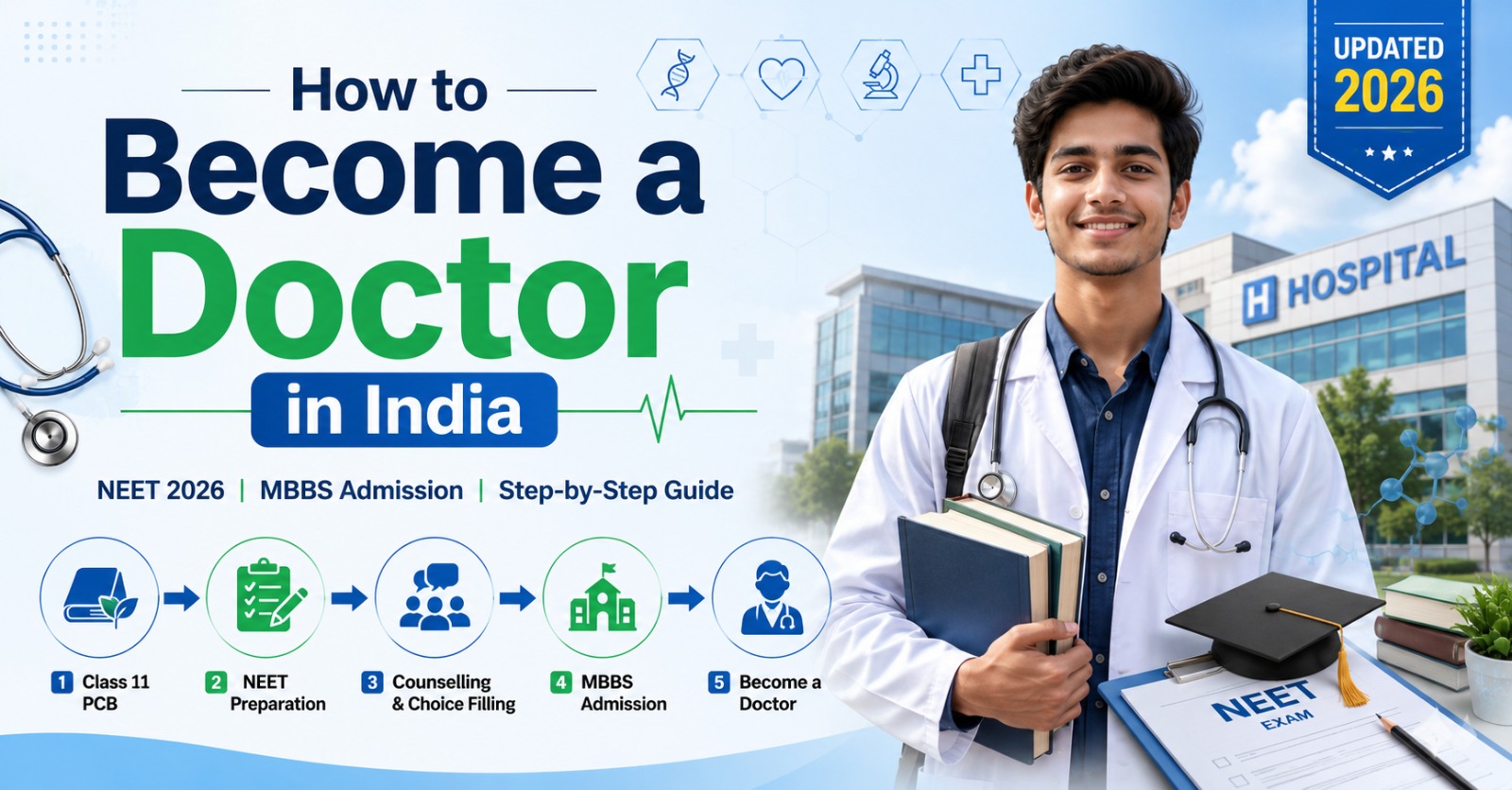
If you're wondering how to become a doctor in India, the short answer is: finish Class 12 with PCB, clear NEET, and navigate the counseling process smartly. But the real journey of how to become a doctor is far more detailed, and most students only realize this once their NEET result is out and admission season begins.
This guide breaks down every stage of how to become a doctor, from choosing the right stream in school to securing a confirmed MBBS seat, using the latest NEET 2026 updates so you're working with current, accurate information rather than outdated advice. Whether you're a Class 11 student just starting out or someone reappearing for NEET, this roadmap on how to become a doctor is meant to simplify a process that often feels overwhelming.
Before diving into how to become a doctor step by step, it helps to understand why so many students choose this path in the first place.
Every year, close to 20-23 lakh students register for NEET UG, making it one of the most competitive entrance exams in the world. Medicine continues to draw students because it offers job security, social respect, and a genuine sense of purpose that few other careers match.
Popular medical courses accessible after NEET include:
Admission to nearly all of these depends on your NEET score, which is why understanding the exam and the medical college admission process matters just as much as studying hard.
The starting point for how to become a doctor is picking Physics, Chemistry, and Biology in Class 11, since every later step depends on the foundation you build here. This isn't just a formality — these three subjects form nearly the entire base of the NEET syllabus, so treating your board exam preparation and NEET preparation as separate tracks is a mistake many students make and later regret.
Focus especially on Human Physiology, Genetics, Organic Chemistry, and core Physics numericals, since these areas carry heavy weightage in the exam and in your future medical coursework.
Step 2: Clear NEET UG Through Structured Preparation
For most students, this is the toughest stretch on the path of how to become a doctor.
NEET (National Eligibility cum Entrance Test) is conducted by the National Testing Agency (NTA) and remains the only gateway to MBBS, BDS, and most other medical programs in India. For the 2026 cycle, the exam has followed the usual pattern of 180 questions worth 720 marks, split as 45 questions each from Physics and Chemistry and 90 from Biology, with +4 for a correct answer and -1 for an incorrect one.
To be eligible, candidates generally need to be at least 17 years old by December 31 of the admission year and must have passed or be appearing in Class 12 with Physics, Chemistry, Biology/Biotechnology, and English. Minimum qualifying marks in PCB currently stand at around 50% for general category candidates, with relaxed criteria for reserved categories.
Effective NEET preparation typically includes:
Given that lakhs of students compete for a limited number of seats, consistency over months (sometimes years) tends to matter more than last-minute cramming.
A lot of students assume the hardest part is behind them once the result is declared. In reality, this is exactly when strategic decision-making begins. Your rank, not just your raw score, decides:
Two candidates with nearly identical marks can end up in very different colleges purely based on how well they understand and use their rank during counseling.
The MBBS admission process confuses a large number of students and parents because qualifying NEET doesn't automatically mean you get a seat. Admission unfolds in stages:
A single error at any of these stages — a missed deadline, an incorrectly locked choice, or incomplete documentation — can cost a student their preferred college for the entire academic year.
If you've already cleared Class 12 and appeared for NEET, this section is specifically for you. Once your result is out, counseling registration can move fast, and having your paperwork ready in advance saves a lot of last-minute stress. Keep the following documents scanned and physically ready before registration opens:
Missing even one of these at the verification stage can hold up your seat confirmation, so it's worth preparing this file well before results are declared rather than scrambling once counseling rounds begin.
This is the stage where many students realize that how to become a doctor isn't just an academic question anymore — it's a logistical one too. Every counseling cycle, thousands of NEET-qualified students lose good opportunities simply because they don't fully understand reservation policies, fee structures, or how seat matrices actually work across rounds. This is where structured medical admission counseling becomes genuinely valuable, helping students:
After qualifying NEET, students typically go through one or more of the following:
All India Quota (AIQ) Counseling
Choosing the right combination of counseling pathways, and filling choices in the correct order of preference, can significantly change your final outcome. This is the part of NEET counseling guidance that most coaching institutes barely touch upon, since their focus usually ends once the exam is over.
Reading about the process is one thing — actually executing it correctly, under a tight deadline, with your entire future on the line, is another. This is exactly where NEET Guru Chandigarh steps in, and it's worth understanding what they actually bring to the table beyond just "counseling."
Based in Chandigarh, the institute has been working in this space for over 10 years and has reportedly guided more than 7,000 students through NEET counseling to date. Their focus stays squarely on medical admissions — MBBS, BDS, BAMS, BHMS, and B.V.Sc. — while also extending support to NEET PG (MS/MD) aspirants and NRI candidates looking for medical seats.
Here's how their support typically maps onto the journey we've covered above:
State and AIQ counseling support — since roughly 85% of MBBS seats fall under state quota and the remaining 15% are handled through All India Quota via the MCC, students get guided on which pathway realistically suits their rank and domicile.
A personalized, one-on-one approach — rather than generic advice, counseling sessions are built around each student's actual score, rank, category, and college preferences, with realistic admission possibilities mapped out for them.
A college predictor tool — students can get a data-backed sense of which colleges are within reach for their rank before they start filling choices, instead of guessing.
End-to-end documentation help — from verifying eligibility certificates to organizing the paperwork covered in the checklist above, reducing the risk of losing a seat over an avoidable paperwork error.
Transparent, stage-by-stage communication — students are kept informed at every round of counseling rather than being left to track deadlines on their own.
NRI and management quota guidance — for families exploring these routes, the institute also handles the additional documentation and eligibility checks these categories involve.
What seems to set this approach apart is the combination of experienced counselors and insights drawn from students who've already been through the same rounds — so decisions are informed by both data and real outcomes, not just theory.
If you've completed your Class 12 and are now staring at a NEET scorecard wondering what to do next, this is precisely the stage where professional guidance tends to matter most. You can reach NEET Guru Chandigarh directly to discuss your rank and options, rather than trying to piece together counseling rules from scattered forums and outdated blog posts.
Even strong NEET scorers often stumble during admissions. Watch out for:
Not researching colleges beyond their reputation • Missing counseling registration or choice-locking deadlines • Filling choices in the wrong priority order • Ignoring state quota opportunities in favor of AIQ alone • Submitting incomplete or incorrect documentation
Learning how to become a doctor in India isn't just about clearing one exam — it's a multi-stage process that starts with PCB in Class 11, moves through NEET preparation, and culminates in careful, well-informed counseling decisions. If there's one thing worth repeating throughout this guide on how to become a doctor, it's that a good rank alone doesn't guarantee a good college; smart counseling does.
If you've already completed your Class 12 and cleared NEET, the next few weeks matter more than almost any other stage of this journey. With updated exam awareness and hands-on guidance from a team like NEET Guru Chandigarh, aspiring doctors can approach counseling with clarity instead of confusion, and move confidently toward securing their MBBS seat. So the next time someone asks you how to become a doctor, you'll know it takes more than just marks — it takes a plan, the right paperwork, and someone experienced in your corner.